

Alphabet
2026
Abstract
ALPHABET is a procedural system for generating invented yet internally coherent scripts: finite alphabets governed by repeatable rules and capable of composing into words, lines, inscriptions and tablets.
Built in Houdini using VEX, the system separates three independent layers: grammar determines what is written, morphology defines how each glyph is constructed, and ink gives the writing its material behaviour. A single language_seed defines an entire visual language, ensuring that the same letter always returns the same glyph.
This page traces the project’s origins, computational architecture and possible applications, while running a live browser-based specimen of the system.
Credits
Filippo Batavia | Concept & Code
FIG. 01 — Specimen band generated live from seed 874 in the runic regime.
Origins & inspiration
CHAPTER I
The project began with a precise frustration. Most “alien script” generators produce calligraphic noise: isolated marks without recurrence or internal structure, perceived by the eye as texture rather than text.
Yet writing remains recognisable even when it cannot be read. Faced with a page in Georgian, Tamil or Glagolitic, we immediately sense the presence of a system: recurring signs, distributions, hierarchies and rhythm.
The initial question was therefore not how to design a beautiful alphabet, but which minimum conditions allow a set of marks to be perceived as writing.
The references occupy three territories. The first is composed of historical writing systems shaped by explicit structural constraints: the modular construction of Korean Hangul, the angular logic of runes and syllabaries devised by individual authors, such as Sequoyah’s Cherokee.
The second includes speculative, unreadable and asemic scripts: the Voynich manuscript, Luigi Serafini’s Codex Seraphinianus, and the work of Xu Bing and Mirtha Dermisache.
The third is procedural design itself: the principle that an interesting form is not drawn as a fixed result, but emerges from a system of rules, constraints and controlled variation.
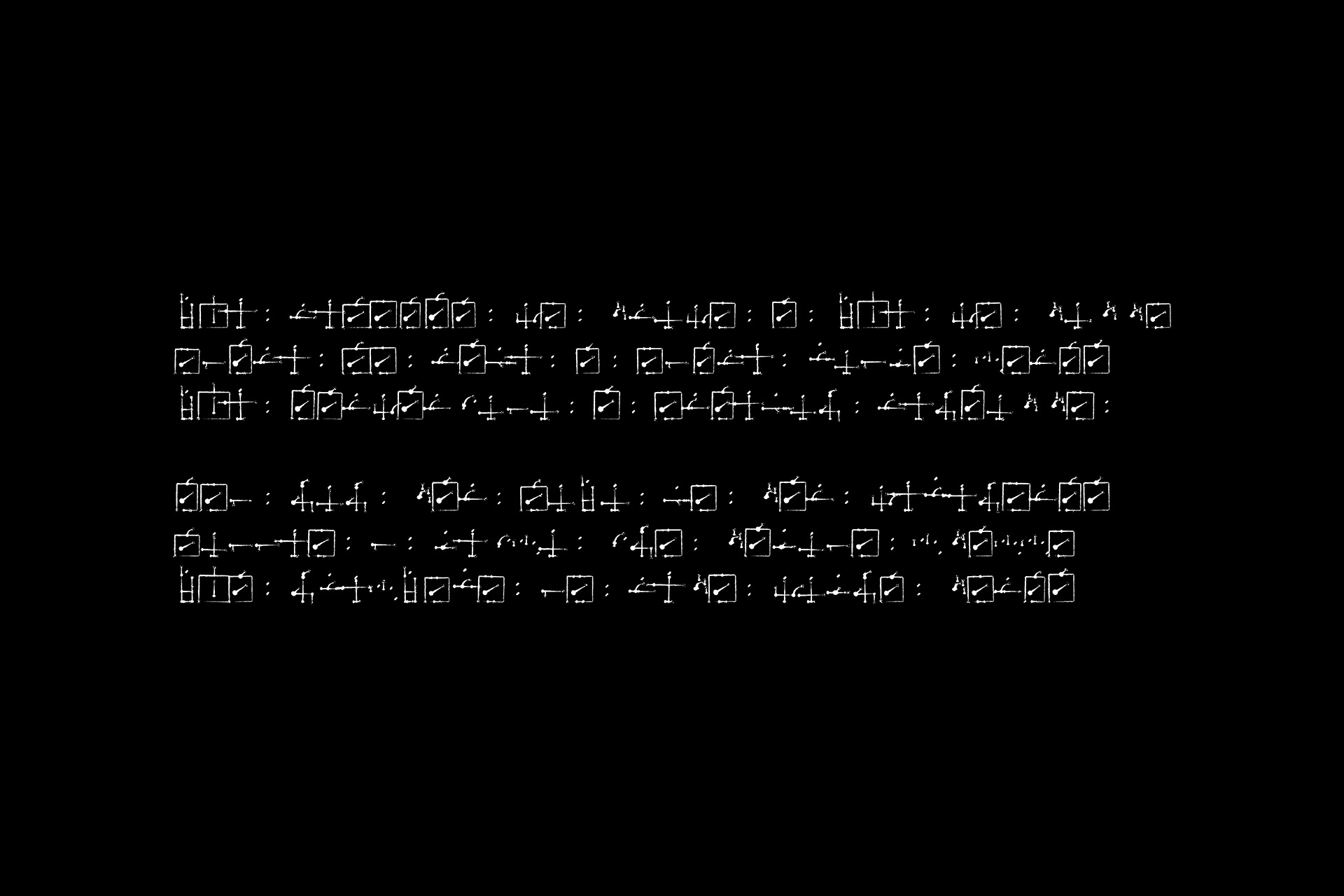
Philosophy: grammar first, aesthetics later
CHAPTER II
The operating principle — grammar first, aesthetics later — suspends the designer’s instinct to begin with the individual glyph. The process starts instead from the conditions that make a script recognisable as a system.
The analysis isolated four fundamental properties.
1 · Recurrence
The same letter must always produce the same glyph. This is guaranteed through seed determinism: each glyph is generated as a pure function of hash(language_seed, letter_id).
2 · Distribution
Natural languages do not distribute their signs uniformly. A limited group of letters appears frequently, while others remain rare. Reproducing this statistical hierarchy through Zipf-like sampling gives the generated language a recognisable internal rhythm.
3 · Formal families
A believable alphabet cannot rely on a single morphological recipe. Latin writing, for example, combines stems, enclosures, crosses, diagonals and arcs.
The first version of ALPHABET was based entirely on a “spine and branches” structure and produced signs that appeared too homogeneous. The introduction of the eight skeletal archetypes described in Chapter V became one of the project’s central discoveries.
4 · Rhythm
Writing is also defined by composition: variable word lengths, spaces, line breaks, direction, opening and closing signs, and the relationship between empty and occupied space.
A speculative consequence follows. If an entire visual language can be generated from a 32-bit integer, more than four billion seeds become potential cultural coordinates.
The role of the designer shifts from drawing every sign to defining the territory in which coherent languages can emerge.
Architecture: what, how, with which hand
CHAPTER III
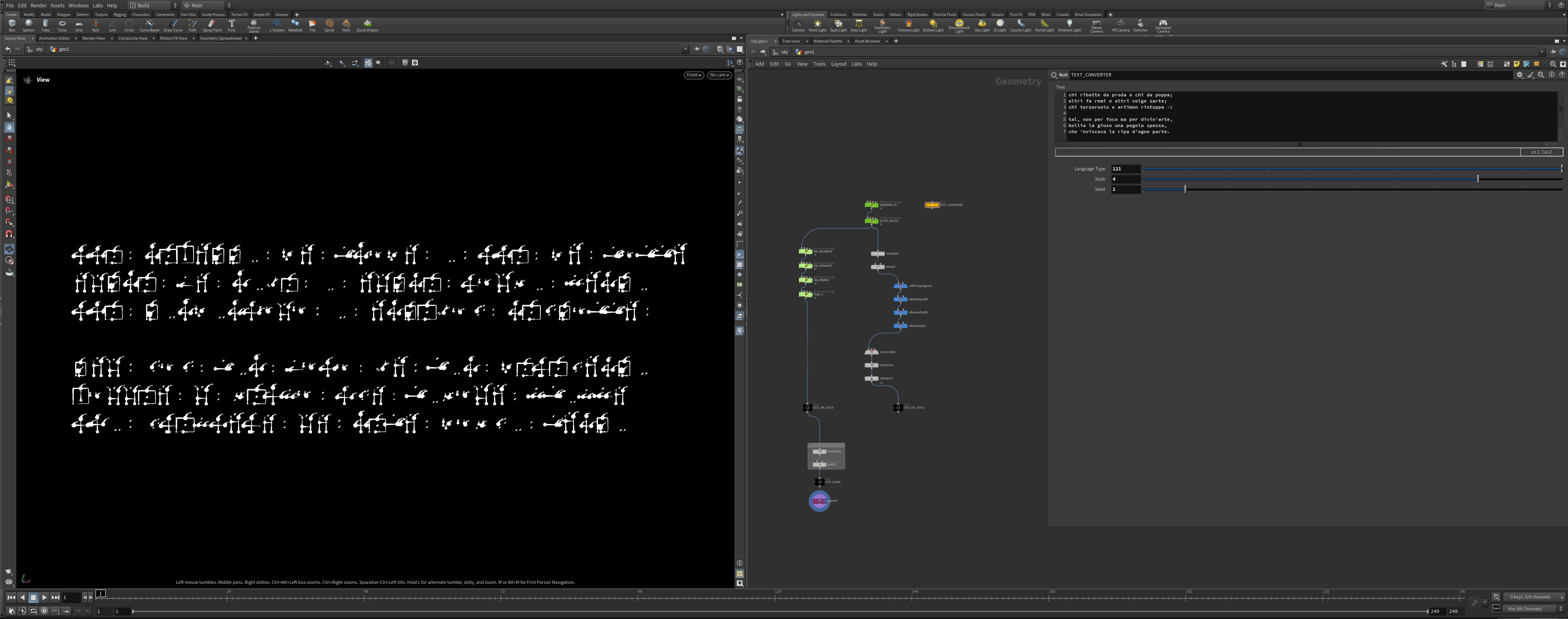
The system lives in Houdini as a chain of Attribute Wrangles written in VEX and executed at Detail level. Its architecture, however, is software-independent: three stages, three responsibilities, no overlap.
This separation is the project’s thesis translated into code: language can change without altering the drawing system, style can change without affecting the grammar, and matter can change without modifying either.
GRAMMAR
GRAMMAR determines what is written.
It generates anchor points in space, one for each symbol. Every anchor carries a letter_id, a glyph_seed, a role, a local scale and a rotation.
This stage manages Zipf distribution, word composition, multi-line text, writing direction and spatial layouts.
GLYPH_BUILD
GLYPH_BUILD determines how each sign is constructed.
For every anchor, it generates a deterministic skeletal archetype, applies the angular rules associated with the selected style, and introduces branches, terminals, ligatures and weight variations.
It knows nothing about the meaning or sequence of the text.
INK
INK determines how the skeleton becomes material writing.
A chain of three VEX stages converts the abstract geometry into a graphic trace shaped by pressure, nib orientation, tremor and ink saturation.
GRAMMAR Detail
Real text or Zipf generation → anchor points carrying letter_id, glyph_seed, role, scale and rotation. Layouts: row, column, grid, spiral and guide curve. LTR and RTL direction per line, multi-line composition, auto-wrap and multiparm tablet generation.
GLYPH_BUILD Detail
Per anchor: deterministic skeletal archetype, angular quantisation, branches, terminal markers, world-space ligatures, weight families and binary-encoded numerals.
INK_RESAMPLE
Constant-arc resampling, interpolated width and curveu generation for downstream dynamics.
INK_DYNAMICS
Pressure taper, flat calligraphic nib, hand tremor, saturation and dry-tail behaviour.
INK_RIBBON
Polyline-to-polygon conversion, onset pools, tail spatter and colour modulation driven by saturation. The resulting two-dimensional geometry is ready for rendering or fabrication.
FIG. 02 — System architecture: three stages, three responsibilities. Grammar cannot draw; morphology cannot read; ink knows nothing of either.
Computational mechanics
CHAPTER IV
At the heart of the system is a simple but decisive function: a deterministic two-argument hash.
The constants are selected to decorrelate the two inputs; the first is Knuth’s multiplicative hashing constant. As a result, neighbouring seeds can produce visually distant languages.
The complete phenotype of a letter descends from its glyph_seed: archetype, number of branches, branch positions, terminals, weight and secondary features.
The letter is not stored as a finished drawing. It is a recipe executed identically every time the sign appears.
// Everything begins here: identical inputs return identical outputs.
float lrand(int a, b)
{
    return rand(a * 2654435761 + b * 97003);
}
// A letter's DNA: a pure function of language and identity.
int glyph_seed = (int)(lrand(language_seed, letter_id) * 1e6);
The grammar of roles
Every anchor carries a role: ordinary letter, word separator, opening sign or closing sign.
Each role draws from a reserved seed pool, allowing punctuation to remain coherent with the language while retaining a distinct morphology. Numerals occupy a dedicated subspace and follow their own construction logic.
The Zipf distribution
Letters are sampled according to a probability proportional to 1 / (rank + 1)^s. The ranking itself is generated as a seed-dependent permutation. Each language therefore acquires not only a visual identity but also its own statistical accent.
This distribution is one of the strongest cues that the output belongs to a writing system rather than to a decorative pattern.
FIG. 03 — Two-seed determinism. language_seed defines the language; text_seed defines only the sequence. The same language-and-letter pair always returns the same glyph.
FIG. 04 — Sampling frequencies for a 24-letter alphabet with s = 1.1. A small number of letters dominate, while the long tail introduces variation. The ranking permutation is a property of the language.
Angular quantisation
THE RULE THAT MAKES A STYLE
The visual identity of a script does not reside exclusively in its individual glyphs, but in the rules governing the directions its strokes are allowed to follow.
The history of writing repeatedly shows how tools and supports shape form. Carving, engraving, brushwork and reed pens each impose their own geometrical possibilities and limitations.
In ALPHABET, this influence becomes an explicit computational law: a single angular quantisation rule transforms the character of an entire visual civilisation.
The system currently includes three regimes. The style also influences the probability assigned to each skeletal archetype: TECHNICAL favours stems, bars and enclosures; RUNIC favours stems and diagonals; ORGANIC gives greater weight to arcs and constellations.
| Style | Angular rule | Character | Analogy |
|---|---|---|---|
| TECHNICAL | multiples of 90° | orthogonal, schematic, circuit-like | lapidary systems and segmented displays |
| RUNIC | multiples of 45° | angular, carved, directional | writing systems shaped by incision, carving and linear tools |
| ORGANIC | free angles and arcs | fluid, cursive, gestural | brush and reed-pen scripts |
FIG. 05 — The same glyph_seed interpreted through three angular regimes. One rule changes; an entire graphic civilisation changes with it.

The eight skeletal archetypes
CHAPTER V
The first version of the system constructed every glyph from a vertical spine and a series of lateral branches.
The result was structurally coherent but too homogeneous. The signs appeared to belong to a single morphological family and tended to read as ideographic rather than alphabetic.
The solution was a taxonomy of eight skeletal archetypes, each based on a distinct constructive strategy.
Every letter selects its archetype deterministically from its own seed, while the probability of each family varies according to the chosen visual regime.
Three further enrichment layers act on top of the skeleton: terminal markers, equivalent to typographic serifs; weight families, ranging from light to bold; and ligatures traced in world space between compatible adjacent glyphs.
FIG. 06 — The eight archetypes generated from real seeds in the runic regime. Each cell displays a distinct constructive strategy and its approximate Latin analogy.

Layout, direction, composition
CHAPTER VI
Writing is a spatial phenomenon before it becomes a linear sequence.
The system supports five composition modes — row, column, grid, spiral and guide curve — together with LTR and RTL direction, correct per-line reversal, multi-line composition and automatic wrapping in generative mode.
The spiral and guide-curve layouts extend the system into an epigraphic territory: circular inscriptions, seals, borders and texts that follow the geometry of an object.
Because the output remains clean procedural geometry, these compositions can be engraved, printed, marked or fabricated directly.
FIG. 07 — Five layouts generated in the same language: row, column, grid, spiral and guide curve.
Ink: simulating the hand
CHAPTER VII
A perfect skeleton remains a diagram.
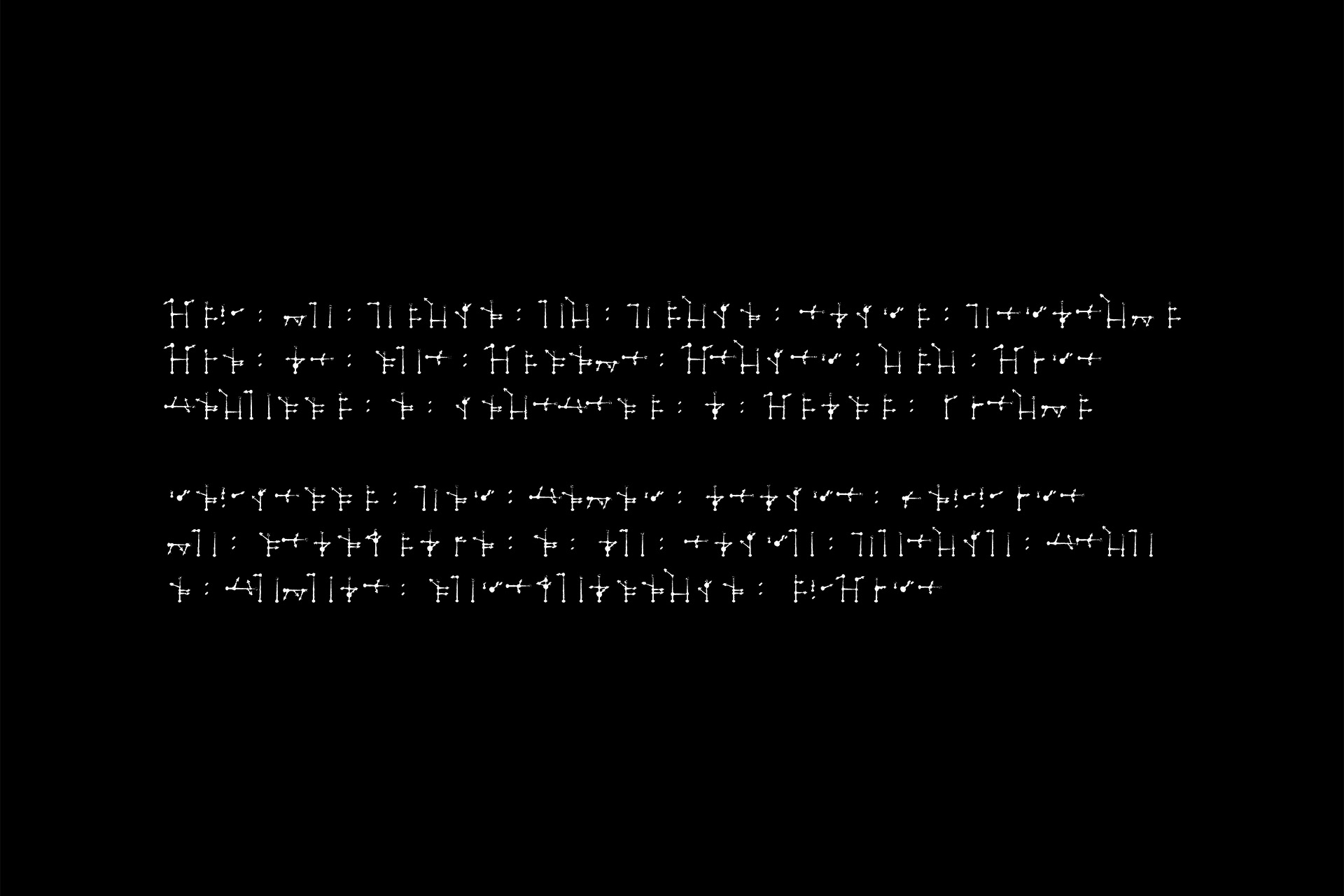
The final stage replaces standard Sweep and PolyWire SOP workflows with an all-VEX chain designed to reproduce the material behaviours associated with handwriting. The credibility of an ancient or unfamiliar script depends as much on controlled irregularity as it does on structural rules.
The system does not merely draw glyphs. It models the conditions through which a hand would leave them.
INK_RESAMPLE
Each stroke is resampled at a constant arc length, while width and the curveu parameter are interpolated for the subsequent stages.
INK_DYNAMICS
Four principal phenomena are introduced:
- Pressure taper: the stroke narrows as the writing instrument is released.
- Flat nib: stroke width changes according to the angle between the trajectory and the nib.
- Tremor: controlled noise is applied perpendicular to the tangent.
- Saturation: the amount of available ink decreases progressively along the stroke.
INK_RIBBON
The polyline is converted into a filled polygon. Additional geometry creates the accumulation of ink at the beginning of the gesture and the small traces left as the instrument lifts away.
FIG. 08 — Anatomy of a stroke: onset pool, pressure body, nib modulation, tremor, dry tail and final spatter. Every phenomenon remains an independent and adjustable parameter.
Live specimen
CHAPTER VIII
This page does not simply illustrate the system. It runs it.
The laboratory below is a JavaScript port of the VEX logic and reproduces the same hash function, skeletal archetypes, angular quantisation and Zipf distribution.
Changing language_seed generates a different visual language: the entire alphabet mutates while retaining its internal consistency.
Changing text_seed produces another sequence within the same language. The alphabet remains unchanged because the identity of every letter continues to derive from the same pair of inputs.
Reusing the same seeds reproduces the same result exactly. No stored state is required: every generated language behaves as an address that can be revisited.
Reproducibility is the signature of the method.
language_seed
Defines the identity of the visual language.
text_seed
Defines the sequence written within that language.
style
Defines the angular and morphological regime.
alphabet_size
Defines the number of available signs.
Alphabet — one letter, one glyph, forever
Sample text — Zipf sampling with words of two to six letters
Applications & perspectives
CHAPTER IX
Worldbuilding & set design
ALPHABET can generate coherent scripts for fictional worlds, including signage, inscriptions, props and diegetic interfaces.
Because every occurrence of a letter is structurally identical to the previous one, the illusion remains consistent even when the writing is viewed at close range or repeated across different objects and environments.
Ritual data visualisation
Replacing Zipf sampling with real data allows every glyph to encode a value.
A time series can become a line of writing, while an entire dataset can be transformed into an inscription or tablet. Information is not represented through conventional charts, but translated into the internal grammar of a generated culture.
Fabrication
The glyph skeletons are clean procedural geometries and can function directly as machine paths for laser engraving, marking, CNC processes or relief 3D printing.
The system can therefore move from screen to matter without requiring the signs to be redrawn manually.
Identity
A seed can operate as a signature: a proprietary visual language that remains reproducible across media, scales and manufacturing processes.
The identity is not defined by a single logo, but by a grammar capable of generating an entire family of coherent marks.
Open directions
Future developments include the introduction of a true phonological system, the simulation of diachronic evolution between related seeds and the extension of the writing system into three-dimensional space.