Mikro
2026
Abstract
Mikro is a browser-based platform for cultivating artificial, bio-inspired systems in real time. Its foundational engine draws on agent-based models of Physarum polycephalum: large populations of autonomous agents sample a shared trail field, move towards stronger signals and reinforce them as they travel. No geometry is prescribed in advance. Networks, membranes and tissue-like structures emerge from the repetition of a small number of local interactions.
The project has gradually evolved into a family of three GPU-based instruments. Mikro Cosmos is the foundational microcosm, centred on the formation of Physarum-like networks. Mikro Continuum turns the behavioural parameter space into a territory that can be navigated continuously. Mikro Worlds introduces inherited traits, mutation, reproduction and environmental selection, allowing multiple artificial populations to develop within the same habitat.
Each system moves large populations of agents in real time and allows their environment to be shaped through food sources, obstacles and spatial constraints. Behavioural parameters determine how the agents sense and move, while colour, iridescence and material rendering determine how their activity becomes visible.
Entirely browser-based and powered by WebGL2, Mikro investigates a form of design in which geometry is not drawn directly. Instead, the designer constructs the conditions under which form can arise, persist, mutate and disappear.
Credits
Filippo Batavia | Concept, Code and Visual Research
Research context
LINEAGE AND ATTRIBUTION
The computational premise of Mikro belongs to the broader lineage of agent-based Physarum models, particularly the work of Jeff Jones on collective behaviour through local sensing and indirect communication.
The project was initially prompted by encountering Sage Jenson’s visual research and Arsiliath’s Unity workshop on Physarum simulation. Their work acted as a point of entry into the subject and as a visual and conceptual reference.
No code, assets or implementation methods from either project were used in Mikro.
The systems presented here were developed separately in WebGL2 and GLSL and progressively expanded into Mikro Cosmos, Mikro Continuum and Mikro Worlds.
The organism as an algorithm
CHAPTER I
Physarum polycephalum is a single-celled organism without a central nervous system, yet it can adapt its body to complex spatial conditions. Placed in a maze with food at different locations, it retracts from unproductive areas and maintains efficient connections between available resources. When nutrients are distributed like the cities of a region, the networks it forms can be compared with engineered transport systems.
Its behaviour is relevant to computation because coordination does not depend on a central controller or an internal representation of the entire environment. Large-scale order arises from processes distributed throughout the organism and from continuous interaction with its surroundings.
A computational model does not reproduce the full biology of Physarum. It isolates a more general principle: simple local decisions, repeated across a population and mediated by a shared environment, can generate organised behaviour at the scale of the whole system.
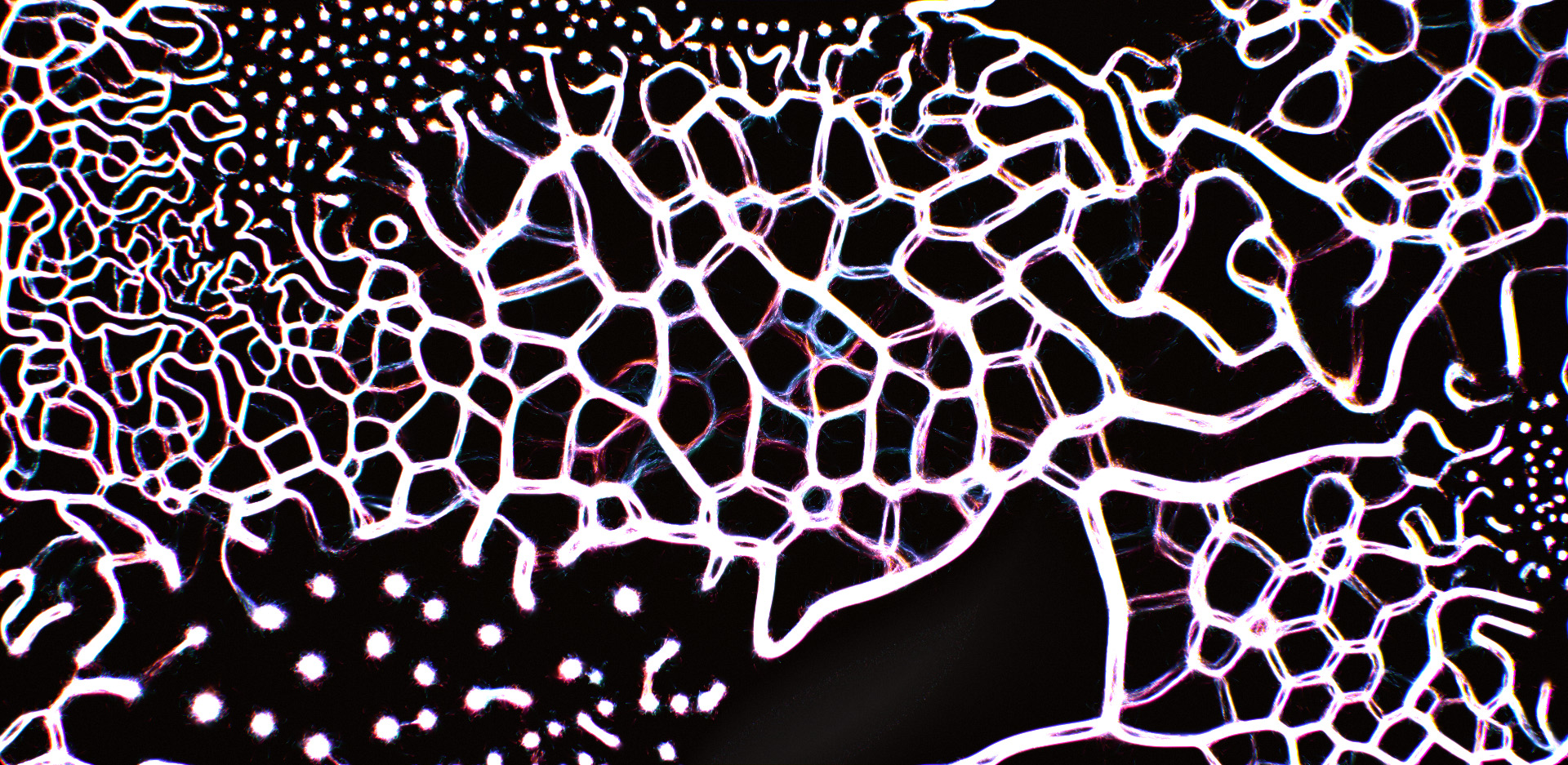
Mikro Cosmos is built around a minimal formulation of this principle: a population of agents, a shared scalar field and four operations repeated every frame. Each agent senses, steers, moves and deposits a trail. The field then diffuses and gradually decays.
Nothing in the code describes a network, a membrane or a filament. Those words describe structures that appear as a consequence of the system’s activity.
The interest of the model lies in the distance between what is written and what is obtained. Its fundamental rule can be understood quickly, yet its consequences remain open to prolonged exploration.
FIG. 01 — The complete cycle. Agents read from the field and write back into it. The field independently spreads and forgets. Agents do not communicate directly with one another.
The agent: four operations
CHAPTER II
Each agent occupies a position in continuous space and carries a direction of travel. At every step, it performs the same sequence: it samples the field through three sensors positioned ahead of it, rotates towards the strongest reading, advances by a fixed distance and deposits a quantity of trail at its new position.
Three parameters govern the geometry of this decision. The sensor angle determines how widely the agent looks. The sensor distance determines how far ahead it samples. The rotation angle limits how sharply it can turn during a single step.
Together with the distance travelled at each update, these parameters are responsible for much of the morphological range of the system. A narrow sensor angle combined with a long sensing distance tends to produce extended filaments with sparse branching. A wider angle and a shorter sensing distance can generate denser structures that curl, overlap and close around empty regions.
The resulting morphology is not encoded as a shape. It is the accumulated consequence of how thousands of agents repeatedly perceive and respond to the same field.
When the sensors return equivalent values, the agent has no directional preference and turns randomly. Within the basic steering rule, this tie-break is the only stochastic decision made during movement. Randomness may also enter through the initial distribution of agents and, in Mikro Worlds, through mutation.
FIG. 02 — Sensor geometry. Three probes form the perceptual apparatus of an agent. Sensor angle, sensor distance and maximum rotation determine how it reads and responds to the surrounding field.
The field: deposition, diffusion, decay
CHAPTER III
The field is the shared memory of the system and the only channel through which agents communicate. It is stored as a single-channel texture with the same dimensions as the simulation space.
Agents write into this texture by depositing a trail at their current positions. They can then sense the traces left by themselves and by the rest of the population. Communication is therefore indirect: an agent does not perceive another agent, but only the modifications that previous movement has produced in the environment.
After deposition, the field undergoes two independent operations. Diffusion spreads each value into its neighbouring cells, giving trails a finite width and allowing agents to perceive them from a distance. Decay gradually reduces the intensity of the whole field, giving each trace a limited lifetime.
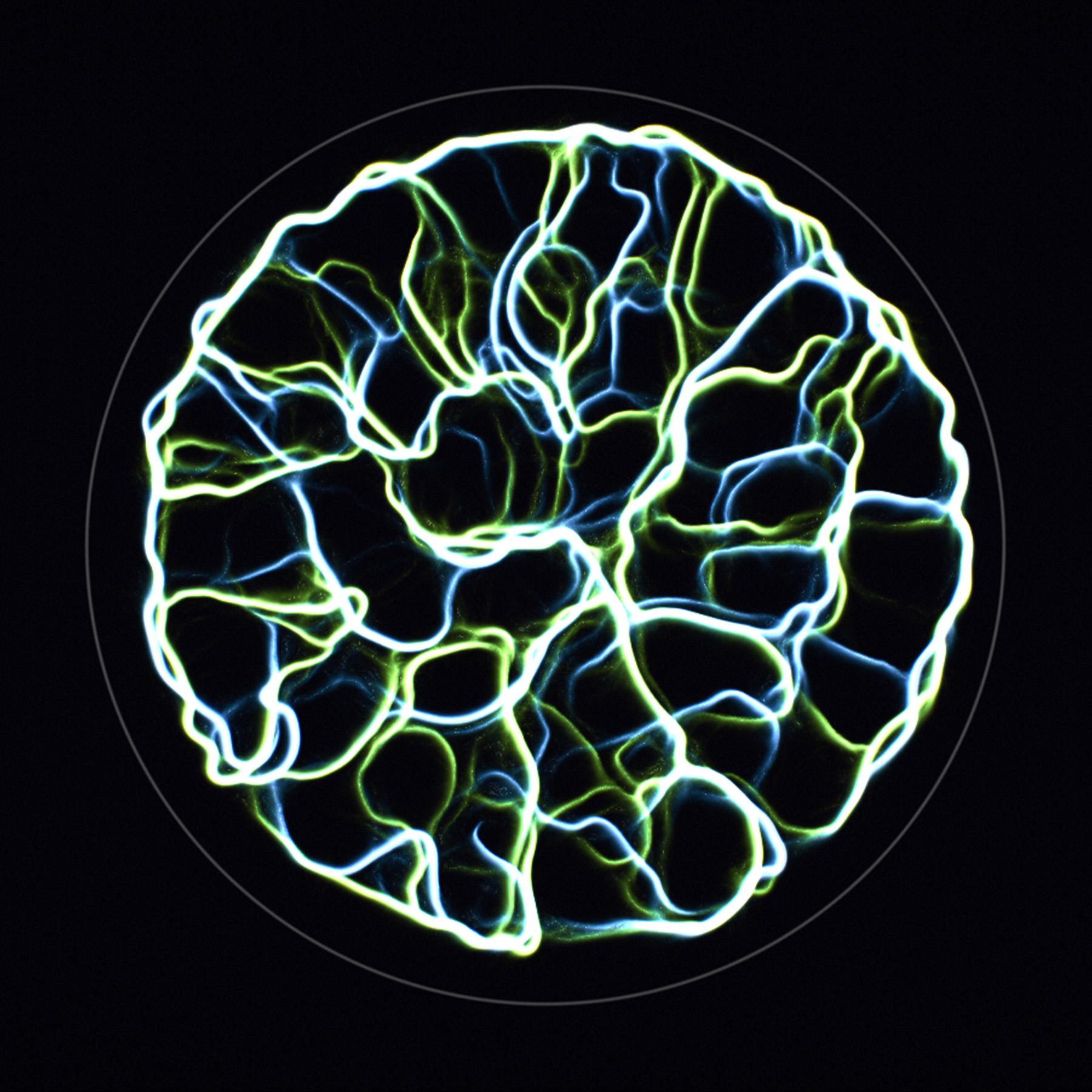
The balance between deposition and decay determines whether a culture develops into a network or dissolves into noise. When decay is too strong, traces disappear before they can be reinforced and the population struggles to organise. When decay is too weak, the field eventually saturates. Every direction becomes attractive and the information contained in the trails is lost.
The useful behavioural regimes occupy a relatively narrow band between these conditions. Much of the parameter space produces either disconnected noise or an undifferentiated fog. For this reason, Mikro is designed for continuous exploration rather than as a collection of isolated presets.
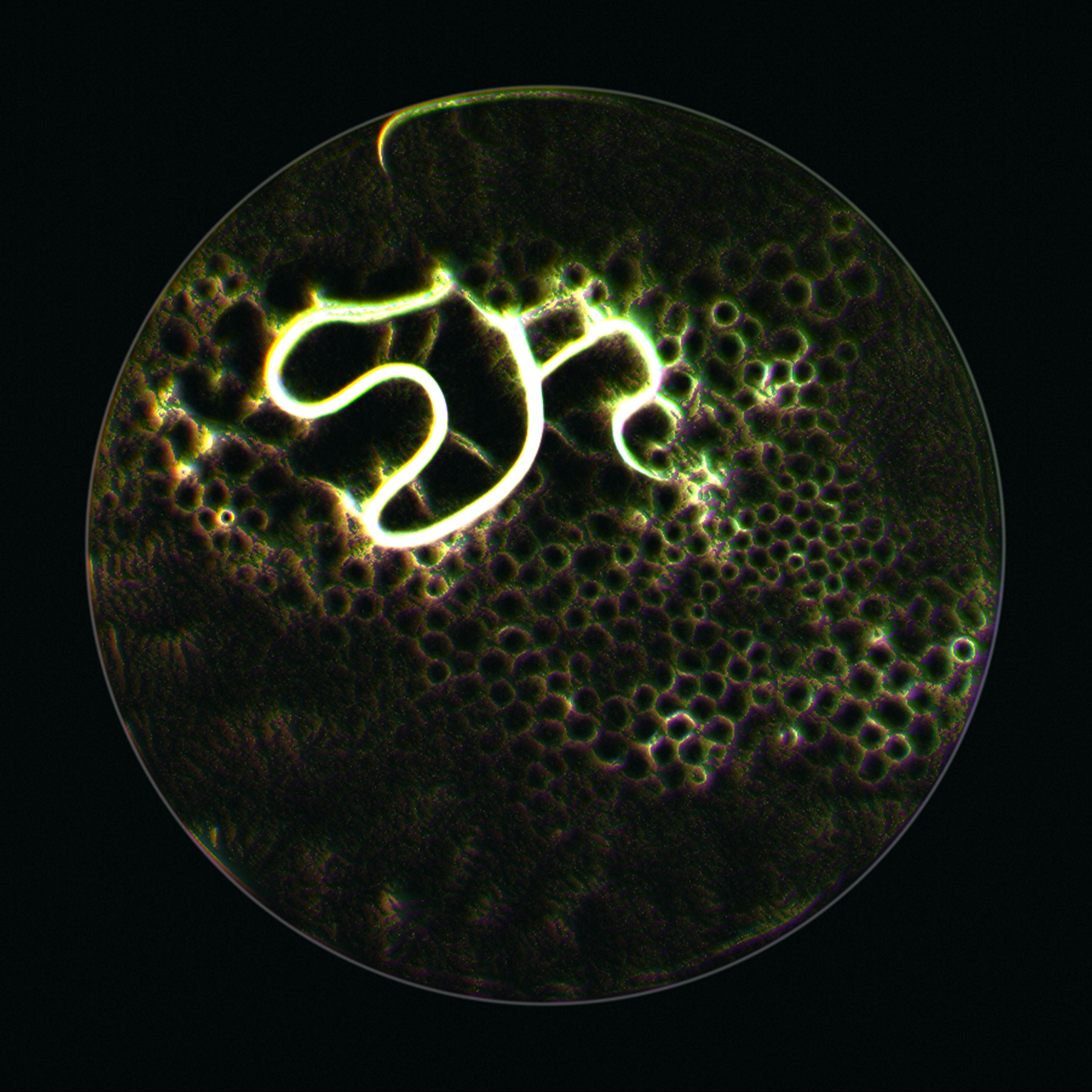
FIG. 03 — The three field operations. Deposition is local and instantaneous. Diffusion is local and cumulative. Decay is applied continuously across the whole field.
Emergence
CHAPTER IV
A run of the foundational system begins with agents distributed across an empty field. At first, they encounter no existing traces and their movement is largely uncoordinated. For the first part of the simulation, the culture appears as noise.
Small asymmetries then begin to accumulate. When several agents cross the same region, their combined deposits create a stronger trail. Other agents are more likely to sense that trail and follow it, reinforcing the same route further.
Once this feedback begins, the field is no longer uniform. The history of previous movements starts to influence future ones, and the population gradually organises around paths that were initially produced by coincidence.
What follows is not growth in the biological sense, but a competition between candidate routes. Paths that carry enough traffic are reinforced faster than decay can erase them. Paths that are used less frequently fade from the field. The structure that remains is therefore a record of repeated use.
In stable cultures, four recurrent phases can usually be recognised: dispersion, the formation of initial filaments, the connection of those filaments into a network and the consolidation of the resulting structure. Their duration, scale and final morphology depend on the parameters of the system.
The outcome may remain a sparse transport network or develop into a continuous tissue. Both emerge from the same basic mechanism.
FIG. 04 — Four recurrent phases of a culture. Dispersion, initial filaments, connected network and consolidation. The diagram is schematic; timing and morphology depend on the parameters and initial conditions.
The habitat
CHAPTER V
An unconstrained field reveals the fundamental behaviour of the agents, but it also isolates the culture from the spatial conditions that make adaptation visible. A completely empty environment can produce complex forms, yet its possibilities are soon exhausted.
Resistance gives the system something to respond to.
The habitat can be shaped directly through food sources, barriers, directional gradients and other environmental constraints. Food adds a persistent signal to the field. Walls prevent agents from crossing particular regions. Gradients introduce directional tendencies into their movement.
These elements are not necessarily independent objects within the simulation. They can be encoded as values, masks or forces operating within the same textures the agents already perceive.
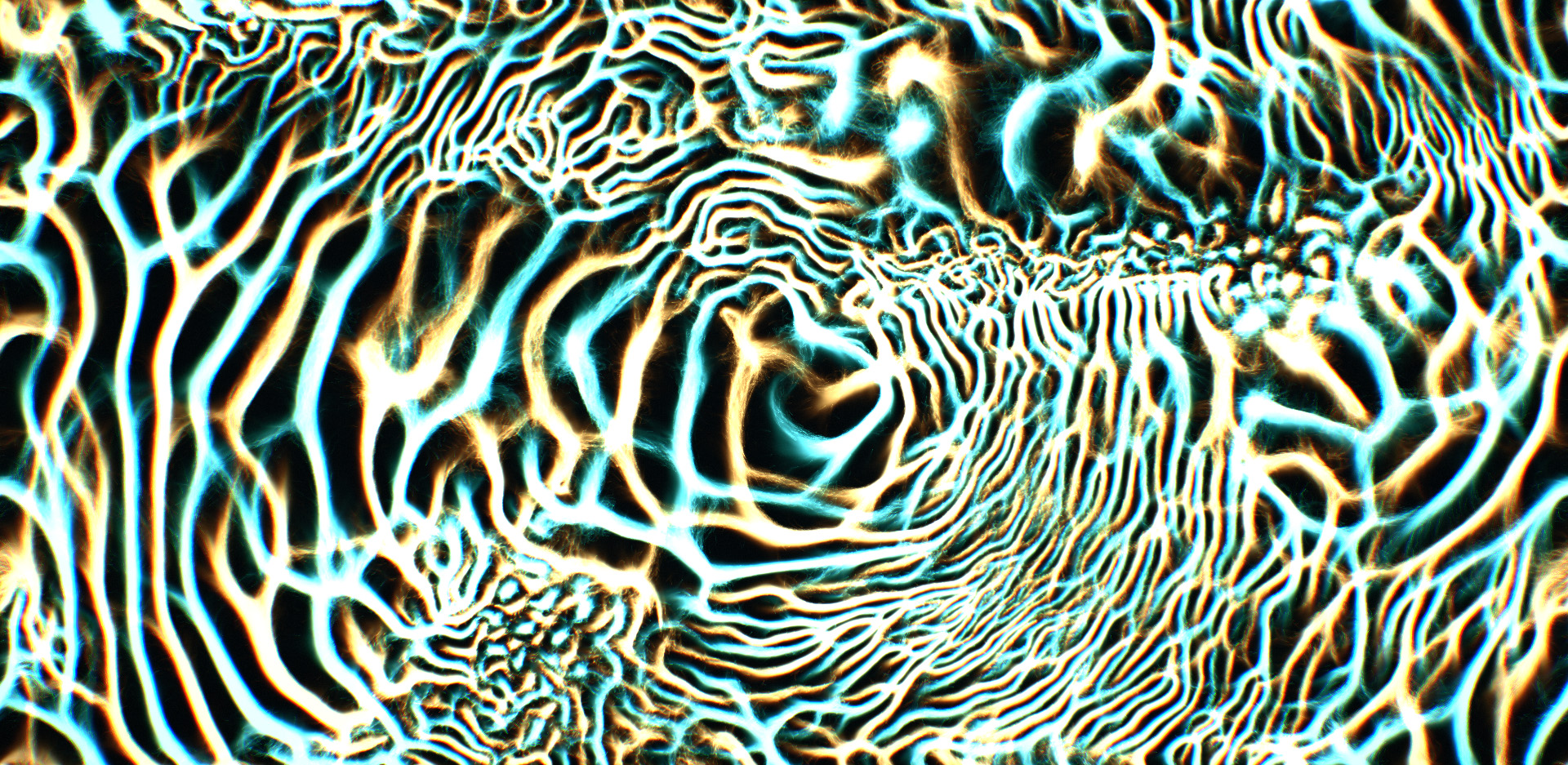
This is the closest the system comes to drawing. The designer does not place an individual filament or determine the final outline of a network. Instead, the designer decides where nourishment is available, where movement is prevented and where passage becomes difficult.
The culture responds by reorganising itself around those decisions. Its resulting structure records both the behaviour of the agents and the character of the environment through which they moved.
The most revealing results often emerge from constraints that are difficult but not impossible: a barrier interrupted by a single opening, two food sources positioned near the limit of connection or a narrow passage that forces many competing routes into the same region.
In these conditions, the form becomes an answer to a problem that was never described geometrically.
Species and the continuum
CHAPTER VI
A parameter configuration behaves in some respects like a genotype. Once a set of values has been established, the resulting cultures tend to retain recognisable characteristics across different runs: a comparable density, branching rhythm, curvature and mode of expansion.
Within Mikro, the word species is used operationally rather than biologically. It describes a reproducible family of behaviours generated by a particular region of the parameter space.
One approach would be to identify successful configurations and preserve them as isolated presets. Presets are useful for returning to known behaviours, but they conceal what exists between them.
The intermediate regions of the parameter space often contain the most unexpected forms.
Moving continuously between two configurations allows one behaviour to transform into another while the simulation is running. A filamentous culture may gradually thicken into tissue. A radial organism may begin to branch. A dense surface may separate into a sparse network.
These transitions are not simple crossfades between images. The agents continue to move and respond while the rules governing their behaviour are changing. The system must reorganise itself through every intermediate condition.
Mikro Continuum was developed to explore this territory. Rather than presenting behavioural configurations as a list of discrete choices, it treats the parameter space as a navigable environment.
A species is a position. A continuum is a path through positions.
The transition itself becomes an object of observation, and the states found between established configurations are often more productive than either endpoint.
FIG. 05 — A simplified behavioural space. A species occupies a region within it; a continuum describes a path through several regions. The band of stable and morphologically distinct behaviours is narrower than it initially appears.
Evolution
CHAPTER VII
In Mikro Worlds, behavioural parameters are no longer applied globally to the whole population. Each agent carries its own set of traits and can transmit them when it reproduces.
The inherited values are not copied perfectly. Small mutations introduce differences in sensing, movement and interaction with the field. As these differences accumulate, the population becomes heterogeneous.
Reproduction is conditioned by the environment. An agent occupying a sufficiently nourished region may divide, while one remaining in an exhausted region may disappear. There is no separate global fitness score assigned to the agents. Selection emerges from local rules governing nourishment, reproduction and death.
The result is closer to an artificial ecology than to a single generative texture.
Populations with different sensing and movement strategies can occupy distinct regions of the same habitat. They expand, meet at boundaries and compete for access to the field. One population may displace another, but the most successful strategy is not necessarily the one that expands most rapidly.
A slower population may use resources more efficiently. A highly specialised one may dominate a particular region while failing elsewhere. Environmental constraints can favour behaviours that would disappear in a uniform space.
Runs of this kind acquire a history. Their development depends on initial distributions, individual encounters, mutations and the order in which different populations reach available resources.
For this reason, two runs generated from the same global parameter configuration may diverge. A particular result cannot be recovered through parameter tuning alone; its evolving state must also be preserved.
Mikro Worlds therefore shifts the focus from generating a form to observing the development of a population. The significant output is no longer only the final image, but the sequence of adaptations, competitions and extinctions that produced it.
Matter and image
CHAPTER VIII
A simulation is not yet an image.
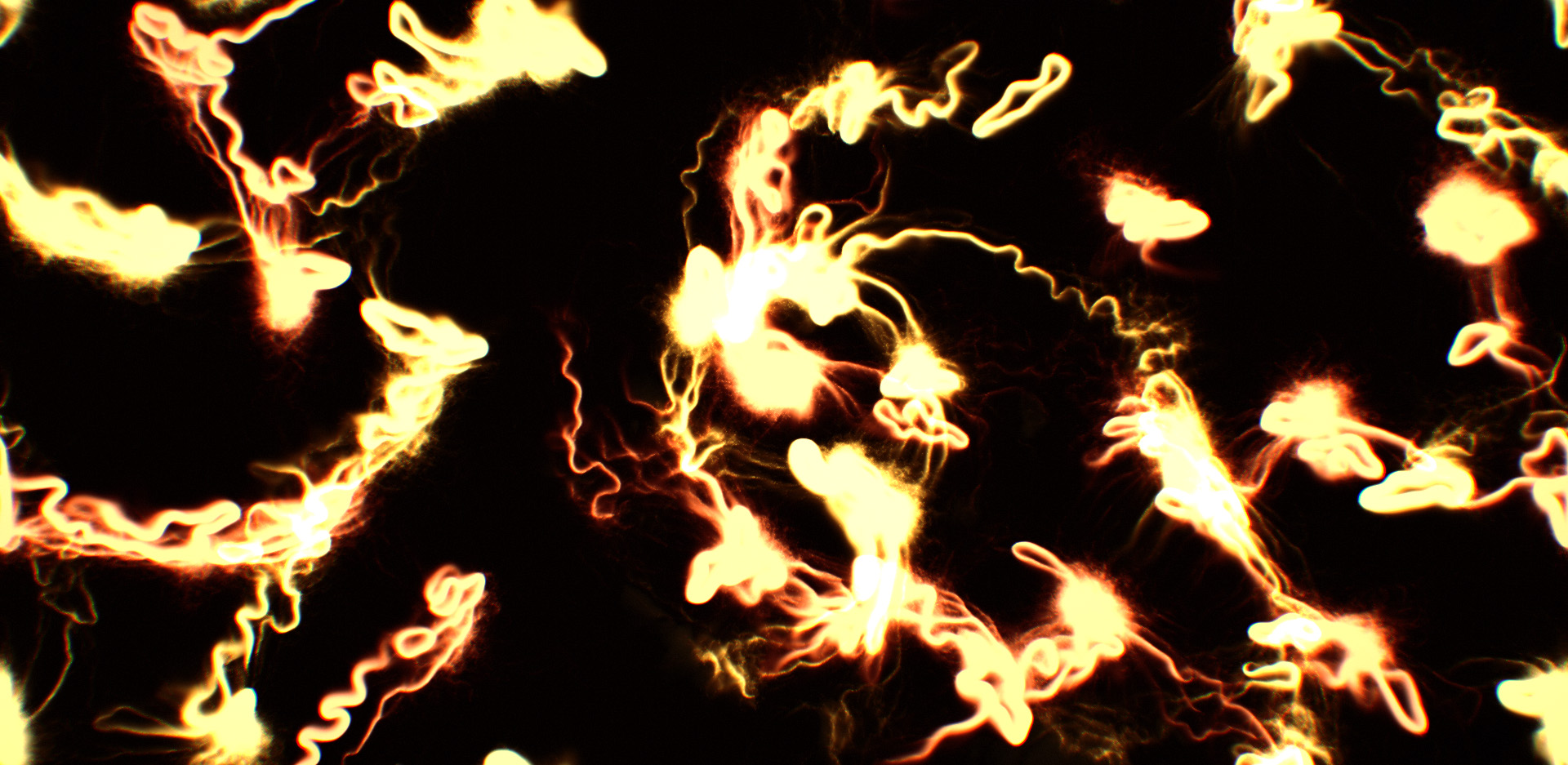
The same culture can be presented as ink spreading across paper, as translucent biological tissue or as oxidised metal without altering the rules governing the agents. The underlying behaviour remains the same, but the interpretation of the structure changes.
Rendering is therefore treated as a material decision rather than as a decorative post-process. Colour, contrast, transparency and surface response determine which aspects of the system become legible and what kind of object the viewer believes they are observing.
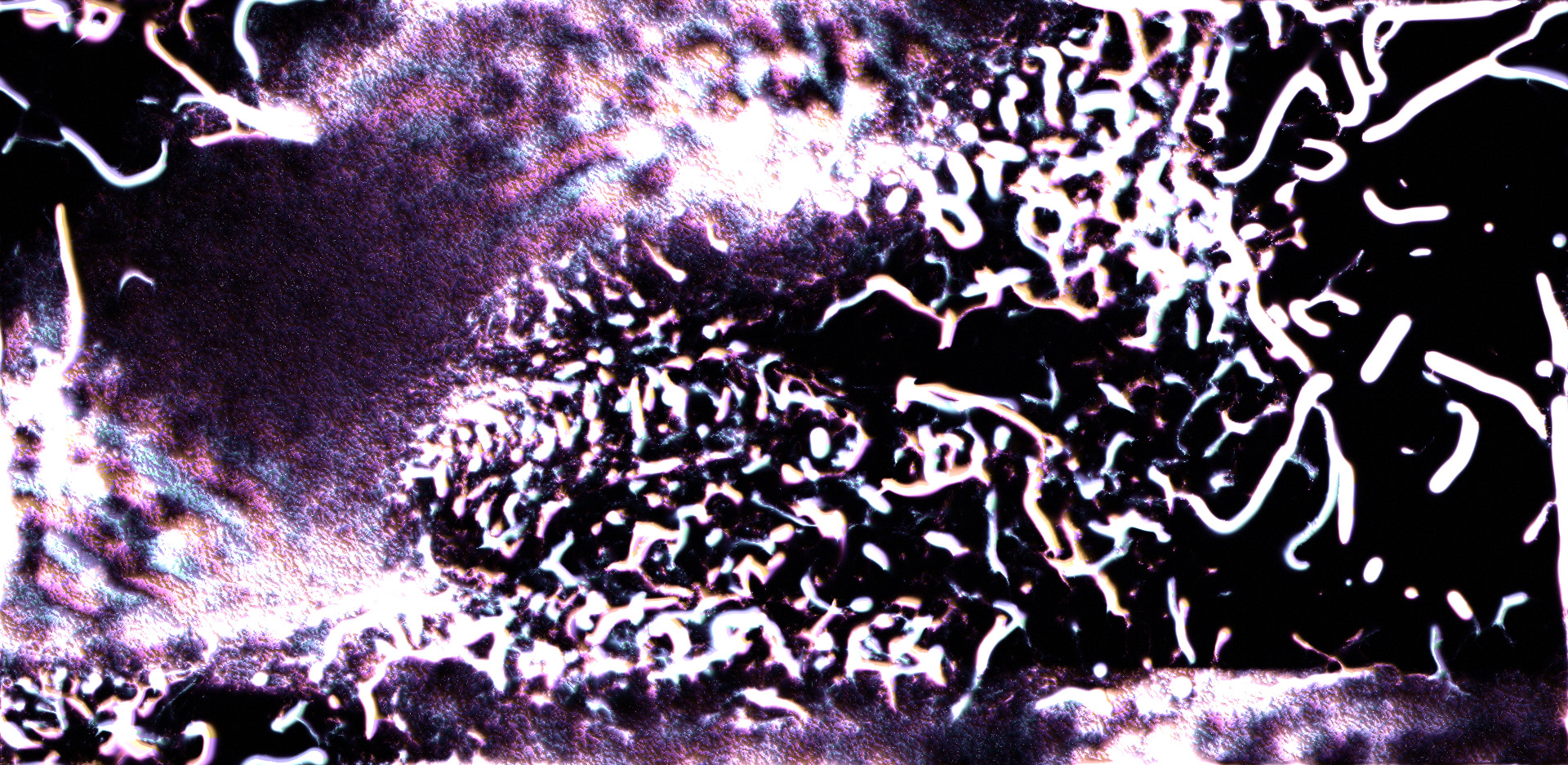
A high-contrast monochrome rendering emphasises routes and connectivity. A translucent palette reveals overlapping densities. Iridescence can give direction and depth to regions that would otherwise appear flat.
The visual layer is part of the research instrument because it determines how the behaviour can be inspected. It can reveal the persistence of trails, the density of traffic, the coexistence of populations or the gradual consolidation of a field.
A result must preserve both this visible state and the system that generated it.
Palette
Field intensity and agent attributes are mapped through a four-stop palette rather than a single colour. The same structure can therefore be interpreted as ink, tissue, mineral matter or metal without changing the behaviour of the simulation.
Iridescence
A view-dependent colour shift, visually inspired by thin-film interference, is applied over the base palette. It gives dense regions a sense of orientation and depth that cannot be produced through flat colour mapping alone.
Export
Two complementary outputs are retained. A PNG preserves the visible appearance of a particular moment. A JSON file records the generative configuration and the state information required to revisit the system rather than merely approximate its appearance.
Performance
Agent data and field information are stored and processed through GPU textures in WebGL2. This allows sufficiently large populations for collective patterns to become visible while they are forming, directly in a browser and without a separate installation.
Growing instead of drawing
CHAPTER IX
The authorship of Mikro is located in two different moments, neither of which corresponds directly to the surface of the final image.
Upstream, authorship lies in the construction of the system: the rules assigned to the agents, the thresholds governing their behaviour, the structure of the field and the constraints introduced into the habitat.
Downstream, it lies in observation and selection: recognising which of the thousands of transient states passing across the screen should be preserved as a result.
Between these two moments, the process cannot be edited locally. It can only be steered.
A stroke cannot be displaced after it appears. An individual filament cannot be lengthened or corrected. The designer can change the parameters, alter the habitat or introduce a new constraint, but the culture must produce its own response.
This restriction is deliberate.
It produces forms that remain coherent across multiple scales, are never repeated in precisely the same way and frequently extend beyond the intention that initiated them. The designer establishes a behavioural space but does not control every event that takes place inside it.
The same principle informs the other procedural investigations in this portfolio, from invented writing systems to compliant lattice structures: complexity is approached not by describing every part of a form, but by identifying the rules through which that form can organise itself.
This changes the way the work is observed.
Watching a culture develop is less like watching a render complete and more like watching an experiment unfold. The relevant question is not simply whether the current image is successful, but what the system is doing, why it is doing it and whether the present state is about to transform into something more significant.
The object of design is no longer only the resulting form. It is the relationship between rules, environment, time and selection.